
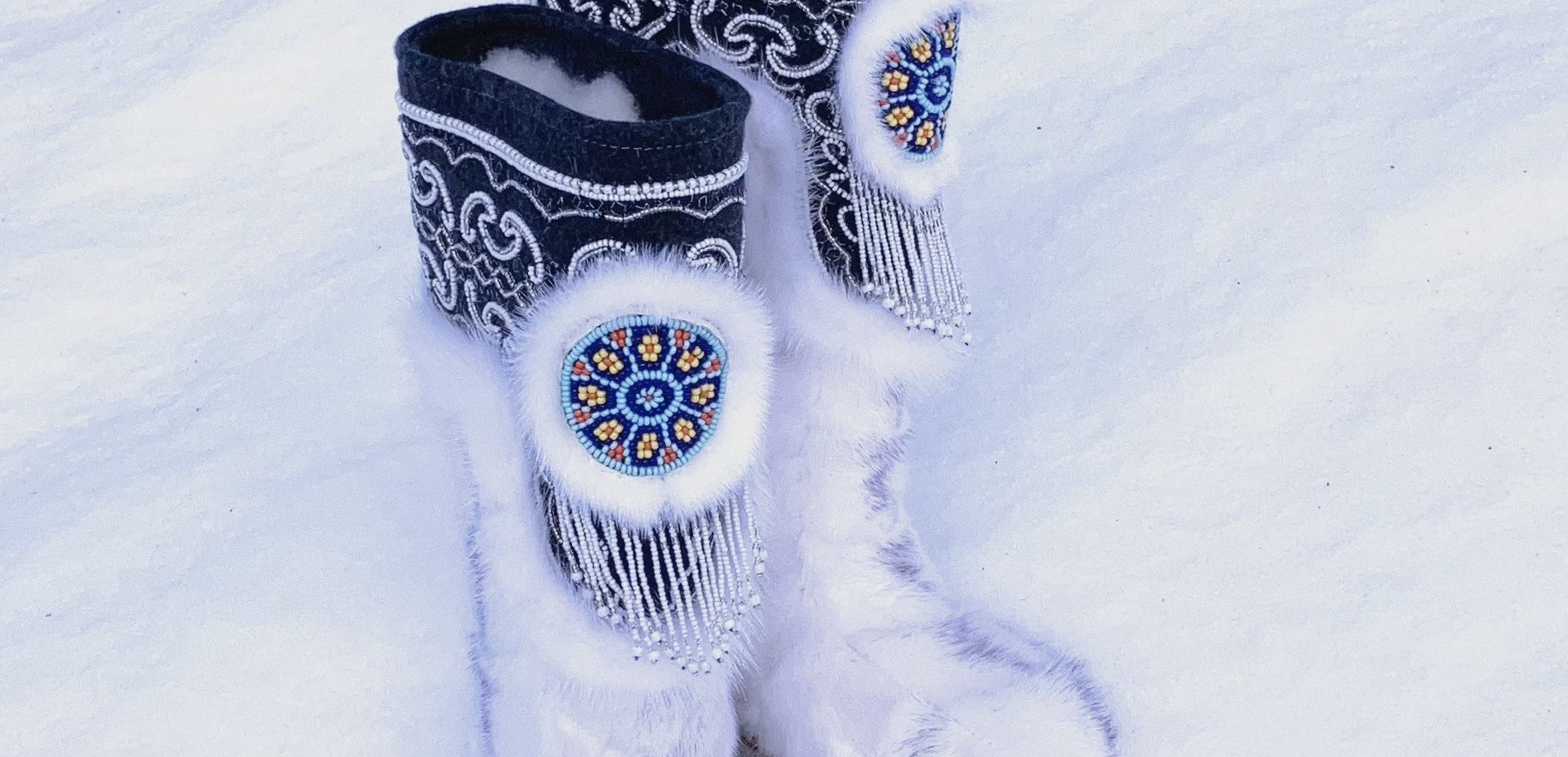
Born from cold.
Made to last.
Every MOGSki piece begins with the same question: what does it actually take to survive the cold?
Not the cold of a brisk autumn walk. Not the cold that a department store boot tolerates for a season before its sole separates and its lining compresses to felt. The cold of the Inner Mongolian steppe at −40°F — the kind that tests every seam, every hide, every decision a maker has ever made.
MOGSki was not designed at a drawing board. It was remembered — surfacing in the middle of a New England snowstorm when the boots a young PhD student trusted completely failed her. In that moment, without thinking, she reached for the knowledge she had carried since childhood on horseback: the thousand-year Mongolian tradition of making boots that survive the worst winter on earth.

The day the boots failed
It was an ordinary afternoon at the University of Connecticut's agricultural farm when the sky changed. Lizanne — a doctoral student in Health Promotion Science, no stranger to discomfort — was riding when the storm arrived without warning.
Her boots soaked through within the hour. The cold that followed was not inconvenient. It was the kind that reaches past your clothing and takes something from you. She went home sick. And she began, slowly, to think.
What she had been wearing, for ten years of horsemanship in one of the coldest inhabited regions on earth, were boots crafted the way Inner Mongolian boots had always been crafted: from natural, undyed animal hides, cut and stitched by artisans who understood that warmth is not a feature to be added — it is a property of the material itself.

The modern outdoor boot — however sophisticated its branding — had replaced this accumulated knowledge with synthetic insulation and treated foam. In a real storm, on a real horse, on a real winter afternoon in New England, it had failed.
Lizanne placed a call to Inner Mongolia. She described what had happened. She asked her artisan to build her a pair of boots for New England — using the techniques and materials of the steppe, translated for a city that did not yet know it needed them.
Chapter III · The Tradition
A thousand years of surviving winter
Inner Mongolia's steppe is one of the most demanding environments in which human civilisation has chosen to take root. Winter temperatures plunge past −40°F. The wind comes without announcement across two thousand kilometres of open grassland. There is nothing between a rider and the horizon — no shelter, no kindness, no margin for error.

The Mongolian boot is one of the oldest continuously produced pieces of functional footwear in the world. The fundamental construction principles have remained largely unchanged because they work: a natural hide upper, a sole designed for the mechanics of horse riding, a shape that allows the foot to stay warm without restricting circulation.
The craft is deeply embedded in nomadic culture. Historically, the ability to make a good boot was an essential household skill — winter survival could depend on whether your footwear was made correctly. These techniques were passed down from mother to daughter across generations.
MOGSki's artisan collaborators in Inner Mongolia are the living continuation of this tradition. The techniques they use are not historical reconstructions — they are the techniques they learned from the women before them.
Chapter IV · The Craft
What a thousand years of artistry looks like
Mongolian boot-making is not a single technique but a complete design language — developed over centuries of intimate engagement between maker, material, and the most demanding climate on earth. Every element of a MOGSki piece reflects a specific inherited decision.
The uppers are cut from natural, undyed hides selected for the density of the grain, the flexibility of the membrane, the particular warmth that only an untreated natural hide carries. No synthetic finish is applied. No chemical dye is used. The hide is allowed to be what it is.
The construction draws on stitching techniques refined over generations — techniques designed not only to hold the boot together but to repel wind, resist moisture at the seam line, and allow the natural hide to breathe in the way that makes it superior to any synthetic insulation. Water moves across the surface of a natural hide the way it moves across the coat of an animal in winter: it does not penetrate. It disperses.
Because the hides are natural and entirely untreated, each MOGSki piece is also exceptionally simple to maintain. A wipe with a clean damp cloth is sufficient for everyday care. The hide requires no specialist products — only the same clean attention you would give to any well-made natural object.

Each pair takes many hours of handwork. The artisan cannot accelerate this. The hide will not allow shortcuts. The stitches are placed by hand, one at a time, in the same sequence and the same rhythm that has been used for generations.
Chapter V · The Material
The hide that was already there
Every MOGSki piece begins with a hide that was already there.
Inner Mongolia has one of the highest rates of cattle and sheep consumption per capita in the world. Every year, the hides of animals raised entirely for food are processed — hides that would otherwise be discarded. MOGSki uses these hides. Not because it is economically convenient, but because it is the only honest use of what already exists.
No animal is raised for a MOGSki boot. No hide is dyed, bleached, or chemically treated. What you hold is what the animal was — the natural colour of its winter coat, the specific pattern of its individual grain, the warmth it carried across a Mongolian plateau.
for MOGSki
no two pieces alike
behind each technique
Chapter VI · The Hands
The women who make it real
MOGSki works with a community of craftswomen in Inner Mongolia — artisans who are not suppliers, but collaborators. Many belong to communities where traditional hide-working and boot-making has been the primary livelihood for generations, and where that livelihood has come under pressure from industrialisation and regional economic change.
Their knowledge is not incidental to MOGSki. It is the brand. The warmth in a MOGSki boot is their understanding of the material. The precision of the stitching is their years of practice. The particular way the hide is prepared — the curing, the softening, the alignment of the grain — reflects decisions that no machine has yet been taught to make.

Chapter VII · The Founder
Lizanne
PhD Candidate, Health Promotion Science, University of Connecticut
Lizanne did not set out to build a luxury brand. She set out to build a better boot — one that would actually work in the New England winter the way the boots of her childhood had worked on the Mongolian steppe. The brand that grew around that first pair was not planned. It followed, logically and inevitably, from the conviction that the thing she was making deserved to exist in the world.
Her academic background in Health Promotion Science is not incidental to MOGSki. A researcher trained in health science brings a particular rigor to questions of material, performance, and the relationship between what we put on our bodies and how they respond. The same evidence-based thinking that drives her doctoral work drives her refusal to use synthetic insulation, artificial dyes, or chemical treatments.
The body knows what it needs. The science confirms what the tradition already understood.

She splits her time between Storrs, Connecticut — where she continues her doctoral research — and the MOGSki atelier in Inner Mongolia, where each season's pieces are made by hand, one at a time, to no deadline other than when they are ready.
Our Promise
Four things we will never compromise
Natural, unaltered hides
Every hide is sourced as a byproduct of the food system. Nothing is dyed, bleached, or treated with synthetic compounds. The colour you see is the colour of the animal's own winter coat — warm, water-resistant, and alive in a way that no treated material can replicate.
No two pieces alike
Because the hides are natural, each piece carries its own unrepeatable pattern of grain and tone. Your MOGSki is not one of a series. It is singular — and it will remain so. The exact piece you hold exists nowhere else on earth.
Made by hand, without hurry
Every MOGSki piece is handcrafted by our artisan community in Inner Mongolia using techniques refined over a thousand years. Production is limited, intentional, and unhurried. We do not run seasonal collections. We make things when they are ready.
Performance before everything
MOGSki is beautiful because it is built for −40°F — not the other way around. Every material decision, every construction choice, every stitch placement begins with the question: does this work in a real winter? Aesthetics follow from that answer, as they always have.
The steppe is still there.
The cold is still real.
Every MOGSki piece carries the memory of a landscape, a tradition, and a woman who refused to accept that genuine warmth had to be sacrificed to modernity. We make things that last — not because longevity is a trend, but because we know what it takes to survive a real winter.