

The MOGSki Journal · Heritage & Craft
The Evenki Sunflower:
An Ancient Symbol,
Hand-Stitched Into Every Boot
A thousand years of protection and hope,
carried quietly from the grasslands of Inner Mongolia to the world.
Deep in the grasslands of Inner Mongolia, where winter arrives without announcement and temperatures fall without mercy, the Evenki people learned something about survival that the modern world has largely forgotten: that what you wear is not merely protection. It is a prayer.
For over a thousand years, Evenki artisans — predominantly women — have embroidered a single motif into the garments of those they love: the sunflower. Not the botanical sunflower of summer gardens, but a stylised, circular design rendered in thousands of tiny glass beads, each one placed by hand, each one carrying a meaning that predates written record. It appears on ceremonial robes, on the boots worn for festivals, on the clothing given as wedding gifts. Wherever it appears, its purpose is the same: to protect the wearer, and to remind them that warmth — true warmth — is something passed between people.
Origins of the Symbol
The Evenki are one of the oldest indigenous peoples of Inner Asia, with communities stretching across the vast arc from Inner Mongolia through Siberia to the Russian Far East. Their relationship with the natural world is not metaphorical — it is literal, practical, and deeply spiritual. The sun, in Evenki cosmology, is not merely a source of light. It is the original protector: the force that turns the frozen earth back toward life, that coaxes the grass to return, that makes the reindeer move north again.
The sunflower motif — circular, radiating, endlessly symmetrical — is a hand-made representation of that solar force. To stitch it into a garment is to carry the sun's protection with you into the cold. To give a garment bearing this symbol is to offer someone the warmth of the sun itself, pressed into textile by your own hands.

To stitch the sunflower is to say: I have thought about your warmth. I have put my time into your protection. You will not face the cold alone.— A reflection on Evenki gift-giving tradition
The Craft Itself
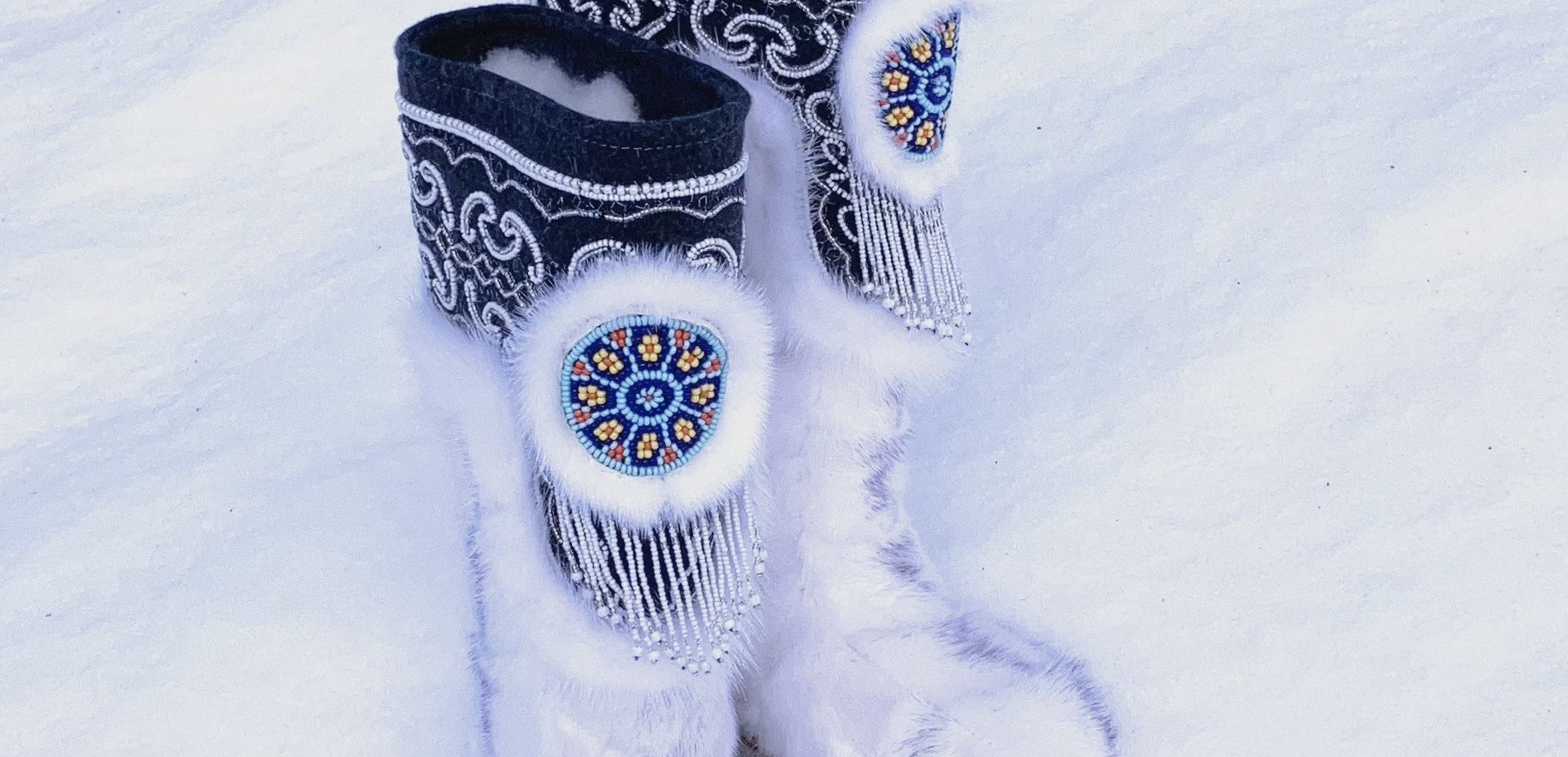
Making the sunflower is not a quick process. A single medallion — the circular beaded centrepiece that appears on the MOGSki ARCTIC MINK CEREMONIAL TALL BOOT — requires several days of sustained, focused work. The artisan begins with a base of dark fabric, stretched and prepared. Then, working outward from the centre in concentric rings, she places each bead individually, threading it onto a fine needle and securing it with a stitch so small it is nearly invisible to the naked eye.
The colour sequence is not arbitrary. Traditional Evenki sunflower medallions follow a specific chromatic order — deep blue at the heart, radiating outward through turquoise, white, gold, and red — each colour corresponding to a different element of the natural world. Blue for sky and water. White for snow and purity. Gold for the sun itself. Red for fire, for life, for the blood that keeps the body warm when everything outside conspires to cool it.
A single sunflower medallion on a MOGSki ARCTIC MINK CEREMONIAL TALL BOOT contains approximately 2,000–3,000 individual glass beads, each placed by hand by Evenki artisans working in Inner Mongolia. The silver bead fringe that cascades beneath the medallion adds a further 200–400 individual beads. No two medallions are precisely alike.
Surrounding the medallion, the upper shaft of the boot is worked in a second technique: hand-embroidered scrollwork in silver thread on a deep black ground. These spiralling, interlocking patterns are drawn from the broader vocabulary of Mongolian and Evenki decorative arts — forms that appear in the carved woodwork of yurts, in the metalwork of ceremonial saddles, in the painted borders of festival tents. They are, in their own way, a language. A visual grammar of belonging, accumulated over centuries and passed from mother to daughter to granddaughter across an unbroken line.


The Women Who Make It
At MOGSki, the sunflower is made by the same community it has always belonged to. Our artisan partners in Inner Mongolia are predominantly Evenki and Mongolian women — many of them from communities that have faced significant economic marginalisation, including women living with physical disabilities and those navigating the particular difficulties of rural unemployment in a region undergoing rapid change.
When MOGSki founder Lizanne began developing the brand during her studies in health promotion sciences at the University of Connecticut, she was motivated not only by the practical frustration of inadequate winter boots — but by something deeper. A desire to take the craft knowledge of her home region seriously. To treat what these women knew as valuable, not merely picturesque. To build a supply chain in which the making of beautiful things was also the making of a livelihood.
Every pair of MOGSki boots bearing the sunflower represents hours of skilled labour by the artisan who made it. The price of the boot is not a premium charged for aesthetics. It is the true cost of craft that takes time, skill, and a living tradition to produce.
The sunflower has always meant: you are protected. We wanted every woman who wears MOGSki to feel exactly that — protected, considered, and connected to something larger than the season.— Lizanne, Founder of MOGSki
Why Every MOGSki Boot Carries the Symbol
Even in MOGSki designs where the full sunflower medallion does not appear, the symbol is present in another form. The hand-knotted Tibetan bead charms that finish the drawstring ties on many of our boots carry their own related meaning — small talismanic objects that nomadic peoples across Inner Asia have used for centuries to mark the boundary between inside and outside, between protected and exposed.
The decision to include these details was never merely decorative. It was a deliberate act of cultural transmission — a way of ensuring that the knowledge of what these symbols mean, and where they come from, travels with the boots into the world. When a woman in New York or Zürich or Tokyo puts on a pair of MOGSki boots, she is wearing something that a community on the other side of the world made with their hands and their history. That connection is real, and we believe it deserves to be named.
The sunflower in Evenki tradition is specifically associated with women's protective knowledge — the understanding that warmth is not passive but active, not merely physical but relational. To make something warm for another person is, in this tradition, one of the highest acts of care. MOGSki was founded on exactly this idea.
Wearing the Sunflower
To own a pair of MOGSki boots bearing the Evenki sunflower is to own something that does not have an equivalent in the contemporary luxury market. It is not a logo. It is not a seasonal motif chosen by a design team in a European studio. It is a symbol with a specific meaning, made by specific people, in a specific place — and its presence on your boot is the physical evidence of a chain of human skill and intention stretching back more than a thousand years.
We do not make many pairs. We cannot. The craft does not permit it. Each ARCTIC MINK CEREMONIAL TALL BOOT is made in very small numbers, and the pace reflects the simple reality of what handwork of this kind requires. What you receive at the end of that wait is not a product. It is an heirloom — one that was warm before you put it on, because the hands that made it already put their warmth into it.


Featured in this story
Arctic Mink
Ceremonial Tall Boot
Natural mink exterior. Hand-embroidered shaft. Evenki sunflower beaded medallion with cascading silver bead fringe. Genuine shearling lining. Handcrafted in Inner Mongolia — each pair unique.
Discover the Boot